
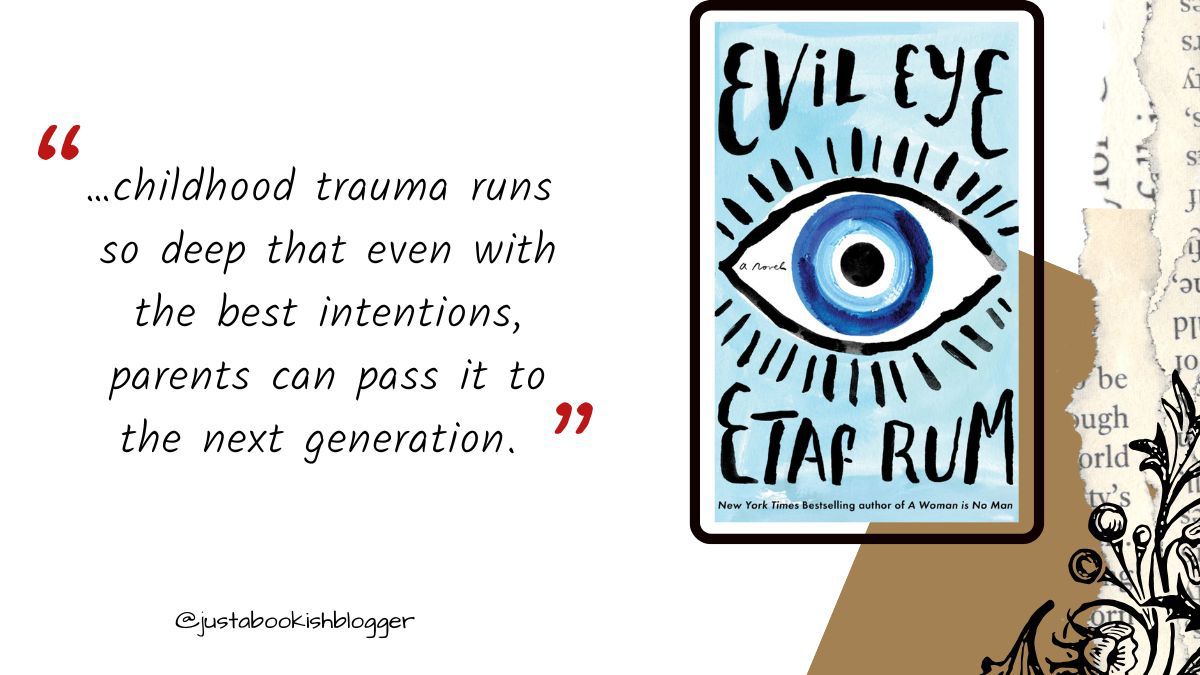
Just like her debut, A Woman is No Man, Etaf Rum invokes the strongest emotions by bringing to life a story that paints a picture of generational trauma and survivor’s guilt. The story revolves around the life of Palestinian American Yara, who tries to steer away from the conventions expected of a traditional wife while trying to understand her own trauma and avoid passing it on to her two daughters.
WARNING: SPOILERS AHEAD
* If you haven’t read the book, head to final thoughts and overall rating
Unlike her mother and grandmother who lived in Palestine, Yara was born and raised in Brooklyn. She has a husband who provides for her, a career and two children. What more could a woman want? Etaf Rum beautifully highlights how in the absence of meaningful connections, even the most glamorous lives can be painfully dull. While Yara’s Instagram paints a picture of a happy family having picnics and a loving husband who remembers birthdays and anniversaries, in reality, her life lacks the happiness and peace she craves for.
As we progress with the story we come to understand that this is because she is forced to accept, that as a child of immigrant parents, this is the most she can hope for. Unlike her parents, she did not grow up in war torn Palestine and had the luxury of being brought up in a safe environment. Etaf Rum shows in her story that this is NOT a luxury. It is a prerequisite of birth. To live in a safe environment is a necessity. Yet, because she is Palestine, she is forced to be grateful for her circumstance and not hope for more.
Yara also has the added disadvantage of being subject to childhood trauma as she grew up in a home where her father beat her mother. While she was not beaten, she was constantly yelled at and often found herself in the middle of their arguments. As a child she was forced to pick sides and suffer the consequences.
Childhood abuse -especially when caused by someone you deeply love and trust, manifests in ways you won’t expect. Sudden outbursts, emotions in extremes and the gradual loss of identity. Yara suffers all of this. Why? Because with time you become so attuned to listening to the words of the perpetrator that you drown your own voice. Bit by little bit your interests wane, your appearance changes, until one day you wake up and you don’t know who you are anymore. It is her loss of identity that makes her crave for something meaningful. Which is why Yara states in the beginning of the novel:
I want to do something with my life
And then a few pages later she reflects:
…she also had dreams of making meaningful work, leaving her mark on the world. She felt certain, in the depths of her being, that something beautiful wanted to be created through her.
And yet reality struck and she was left living a life that she desperately tried to avoid; and she questions:
…Why hadn’t she fought for what she wanted? Why had she surrendered to her parents’ vision of her future?
It doesn’t help that her westernized colleagues see her as the stereotypical housewife:
…how weak and domesticated Yara was, a good little housewife. Oppressed by marriage and motherhood. How very Arab.
Through this story, Etaf Rum shows that even when you are living your best life, it is as though you are living a lie. Your purpose in life is lost. The material benefits that come your way, bring little or no joy and you go about the motions of daily life even though you are pretty much dead inside. Consequently your life becomes monotonous, just like Yara’s. She wakes up every morning, drops off her children to school, goes to work, comes back home, cleans, cooks, stares at the TV and does it all over again the next day.
And when you ask for something better? You are not grateful. When you yearn for meaningful connections – you are not trying hard enough. Coming from a person who is supposed to understand you, especially that of a spouse, this is draining. Which is why even though her husband Fadi “works hard” and spends on his family, his contributions fall flat. He doesn’t make the effort to connect with his wife. Understand her and be present in his relationship. Most women do not want a man who showers them with gifts. The little tokens of appreciation would go a long way as opposed to a fancy dinner and expensive gifts. Which is why it was important for Fadi to book that overseas trip for their anniversary or make it possible for Yara to chaperone the school trip to Europe.
And when that breath of fresh air comes your way – a conversation that hears YOU, sees YOU and understands YOU, it feels euphoric.
Enter Silas – a friend who is going through his own troubles and offers Yara a helping hand to navigate the rough patch in her life. Because even though Yara goes for therapy, she fails to open up with her counselor. And that’s the thing with therapy – while it’s great to help you find the root cause of your problems, it is not a permanent solution. As humans we need meaningful connections on a day to day basis to help process the different events of our life.
But sometimes we find ourselves in situations that provides little or no room for meaningful interactions. Yara for instance is caught between her Arab culture of being a domesticated housewife and the life of an educated, Brooklyn raised individual. There are very few people out there who would fit this particular mold. And thus Etaf Rum questions:
…Why didn’t the world recognize that identity and privilege were accidents of birth?
The loss of identity also comes with a continuous consumption of the “right way to live”. Which is why Yara notes:
…But everywhere she went, every billboard, every magazine, every show on television told her the Western way was how a life was well lived. The gold standard the dream. It left her feeling alienated and detached, a stranger in her own body.
This sense of alienation was something Yara felt even in her hometown back in Palestine. She was neither American nor Palestinian. She was “in-between” and found herself living a life of obedience because:
…she’d learned to feel safer in obedience than to be free
And:
…what will people think?
In the past, this was of course the final nail in the coffin.
Living a life based on “obedience” and “what will people think?” eventually led Yara to lose herself. In the end it’s with the help of Silas and his mother that Yara comes to understand her circumstance. She makes a few bold steps to live life on her own terms; and even taking that extra step to hope for a love that’s not simply “going through the motions”, because:
…the pain of being alone could never compare to the loneliness she felt with him.
Final thoughts
…I know I can’t be a surgeon, or a CEO, or a world-famous painter with exhibits around the globe, or anything that interferes with my duties as a wife and mother.
This quiet admission is profound. It’s a passing comment in the story and yet it touches on some of the predominant themes in the story such as intergenerational trauma, racism, struggle for identity, sexism, independence within cultural expectations and mental health.
If you cannot be what you want to be, then what are you living for? This was the question that was silently posed as the story progressed. Etaf Rum shows that it is never to late to start living and all you need is one bold step to steer you in the right direction.
The topics resonated with me and I feel it’s a great read for anyone who finds themselves at the crossroads of life.
Overall rating: 5/5
Fact box
Author: Etaf Rum
Release date: 5th September, 2023
Genre: Historical fiction and Psychological fiction
 The Bookish Blogger