
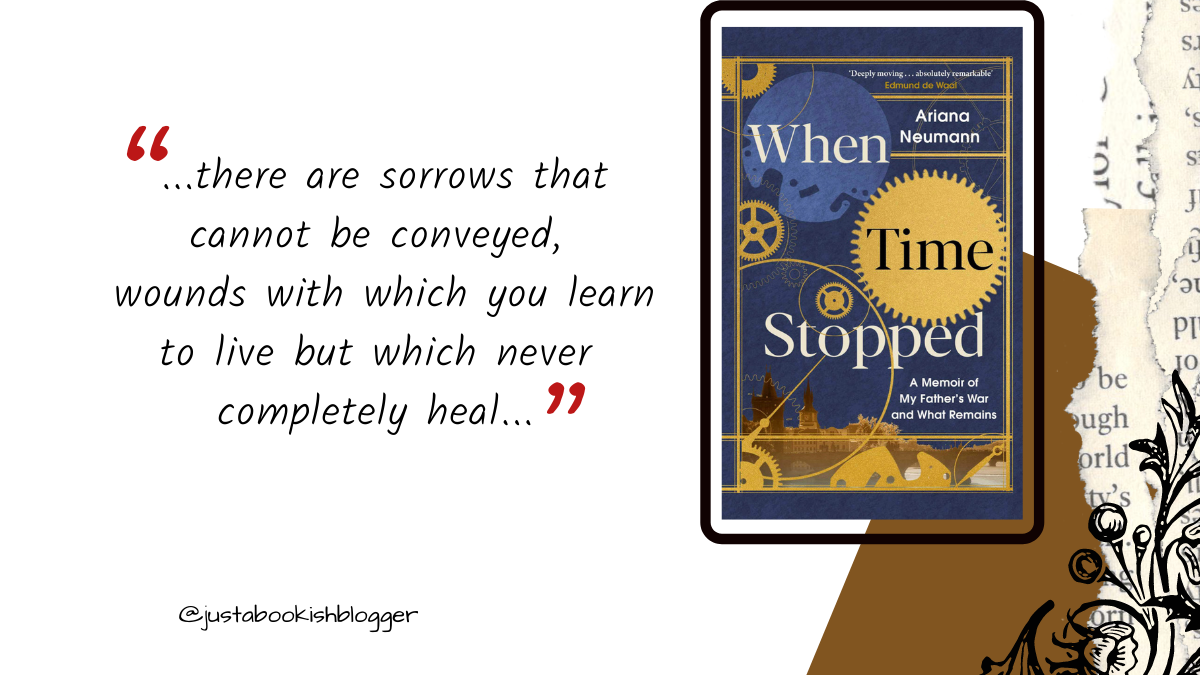
This is the story of a man who survived the holocaust by hiding in plain sight. A man who had to leave behind his name, identity and family to avoid being executed for his genetic construct. It’s only decades later, that his daughter, Ariana Neumann uncovers the astounding story of her father’s mysterious past by painstakingly piecing together the narrative from photographs, letters, official documents and countless interviews from long lost relatives. The end result is a story that will leave you gobsmacked!
The story opens up with Ariana’s visit to the memorial at the Pinkas Synagogue in Prague in 1977. There she discovers a question mark next to her father’s name. Ariana goes on to say that her father was very much alive at this point. However the question mark brought back a flood of memories that made Ariana wonder about her father’s mysterious past. Sadly, it was only after his death a couple of years later that she got her answers.
There was much I did not know about what went on in these camps prior to reading Ariana’s books. So yes, this is the first non-fiction or fictional story I read about the holocaust. I did read the Diary of Anne Frank eons ago, but my memory of its contents is rather vague. I am aware that there have been many books published surrounding the holocaust, (The Tattooist of Auschwitz and The Book Thief have been on my tbr since forever) but for some reason I was drawn to Ariana’s story. I guess this was because it’s true and also Hans’s survival sounds rather daring. That being said, I did learn quite a bit about Nazi occupation in eastern Europe and its surroundings.
Three things I learnt about Nazi occupation in eastern Europe:
- When the Nazis marched into Vienna in 1938, Hitler annexed Austria in a union known as the Anschluss. Austrian Jews lost their right to vote, they were deprived of legal rights and subject to public humiliation – scrub the streets with their toothbrushes or consume grass like donkeys. (p.72) They were deprived of essential food items including sugar and coffee and medicine. (p. 124)
- Throughout 1939, laws were passed that banned Jews from literally everything. Jewish pupils were expelled, they could not be lawyers, teachers or journalists. All Jews were required to register their belongings including jewelry. They were banned from restaurants, parks and theaters. They were not allowed to travel without a permit and eventually they had to surrender everything. (P.93)
- Terezin was the camp used for Nazi propoganda. It was originally a garrison town built to accommodate 4000 people, but by 1942, it housed nearly 60,000 people. (p.177) It had no gas chambers, although 34,000 people perished from disease and starvation within its overcrowded confines. It was used for Nazi propaganda because it had a bank, post office and a working hospital. While the bank and post office were a charade, the hospital functioned, staffed by doctors who were deported from all over Europe. (p.180)
While I knew that the Jews were subject to inhumane treatment during the Nazi reign, I was not aware of the magnitude of it. Stripping them of their rights and belongings and reducing them to a rather animalistic existence is absolutely horrifying! There were many Jews who chose to be executed than suffer the humiliation inflicted upon them by the Nazis. Such was the magnitude of the horrors they faced on a day to day basis.
This book was picked for my November reading challenge and unfortunately I was the only one who completed the book. Those who tried said that the descriptions were too long and tiresome and Ariana has dramatized the narrative. Here’s my take on that:
Has Ariana dramatized the narrative?
When I started reading I felt Ariana had added too much colour into her descriptions of feelings and emotions. The mechanical movements of a watch which ran into three agonizing pages made zero sense. And why would Ariana describe its workings with so much detail? I understood this, only on completing the book. Ariana has a rather novel theme encapsulating the narrative of her father, that of time. The book is titled When time stopped because that’s how her father felt when he was hiding from the Nazis. Ariana beautifully illustrates this in her story:
…sometimes you just feel that everything around you has come to an end. You feel that you’re completely alone, that time is frozen and that you’re invisible. At first you might feel exhilarated by the sense of freedom, but then you’ll be frightened that you are lost and you will never be able to go back…” P.207
Hans Neumann was so petrified and dumbfounded by the situation he was in, he thought that he was frozen in time. To ensure he wasn’t “…he opened his watch case to verify that time indeed was passing…the turning wheels, ticking each second away, reassured him.”
Ariana goes on to explain that since then her father habitually broke open watches to ensure that the ticking sound “…was not only inside his head…and time was real and going by“. She says in p.208 “When everything around him seemed frozen and he was lost and invisible, my father oriented himself by learning how those minute spinning wheels worked with such perfect precision that they managed to keep time.”
This truly broke my heart. Imagine being this petrified. It was around this point I realized that Ariana has not dramatized her father’s narrative. Right into adulthood Ariana knew nothing about her father’s past. Nothing about his life running away from the Nazis, losing his parents in the gas chamber and living a life as a Jew in eastern Europe. I can only imagine how she felt when she stumbled upon these pieces of information. Putting them together would have been a Herculean task and she would have had to separate emotion from fact. Yes, the descriptions are long, but it is what encapsulates the theme of time running through the story.
Final thoughts
Were the long descriptions necessary? This is a memoir and memoirs do have descriptive elements, sometime a tad bit too long. Unfortunately while I understood the point of these descriptions on completing the book, many didn’t because they did not get past the first chapter. I feel that if Ariana had started the story with the accounts from p. 207 of her father being frozen in time, trapped behind a factory wall – more people would have read her book. It’s a good story that needs a couple of editorial revisions.
Overall rating: 3.5/5
Fact box
Author: Ariana Neumann
Release date: 4th February, 2020
Genre: Non-fiction, memoir, autobiography
 The Bookish Blogger