
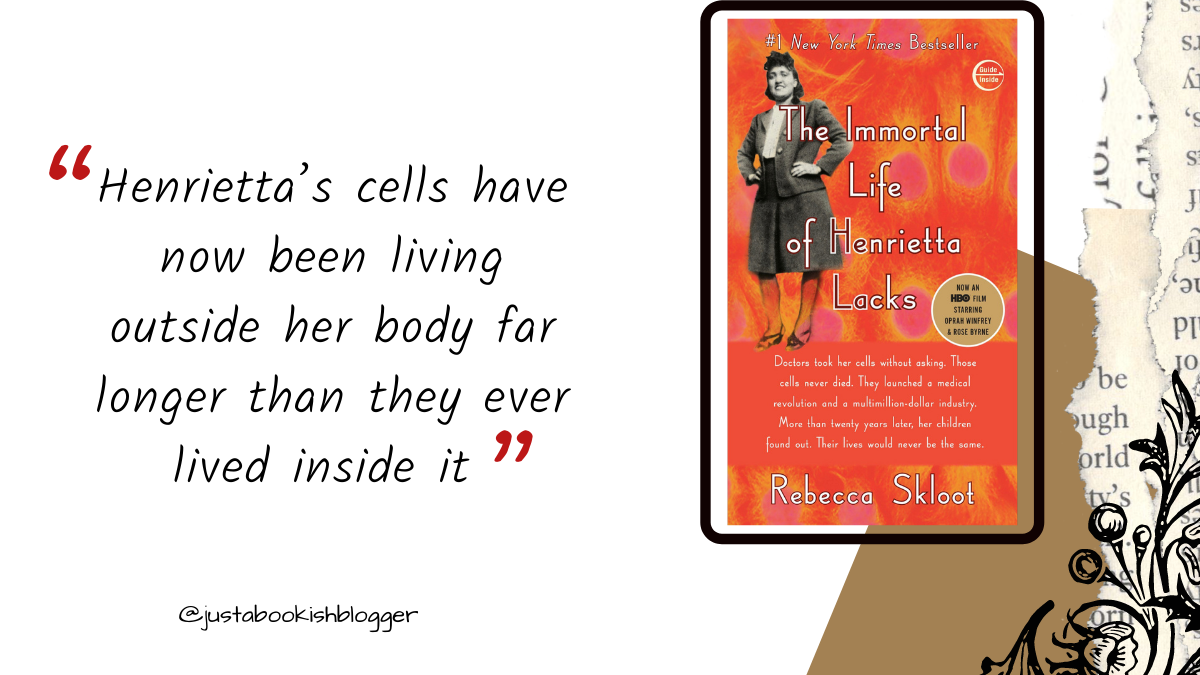
The Immortal Life of Henrietta Lacks is based on the extraordinary journey of Rebecca Skloot in uncovering the life of Henrietta Lacks whose cells, named HeLa, contributed towards advancing both medical and technological research. While her cells helped launch a multi-million dollar industry that sells human biological materials, her family never saw any profits. It is sad considering that they all had some medical condition and not only did they have to pay for their medicines, but they did not even have proper access as they were people of colour.
Henrietta’s family was religious, believing in faith healing and voodoo for curing illnesses. It was way beyond their wildest imagination that Henrietta’s cells could be immortal and were paving the way for scientific and technological breakthroughs.
In addition to uncovering the remarkable life of the woman behind the cells, this book also paints a descriptive picture of women in their different roles as a daughter (Deborah), wife (Henrietta), mother (Henrietta and Bobbette) and a career person (Rebekka Skloot). They all deserve a standing ovation for the different roles they played in the overall story and I was honestly in awe of all of them. I wish I could be as ballsy as Bobbette and determined as Skloot and Deborah. Working as a journalist myself for nearly two years, I found Skloot’s persistence to get the story factually correct and balanced remarkable! I don’t remember if I read it in the book or some article, but I know that it took her ten years of research, a divorce and unfathomable challenges to get the facts right in Henrietta’s story. Which is why to me, while Henrietta is a legend in the field of research, Skloot here is the unsung hero – if not for her persistence and dedication to get the story right we would still be living in a world where we did not know HeLa and its remarkable significance.
A couple of shocking facts and stats I learnt from this book:
- Nazi doctors conducted research on Jews without their consent. They stitched their siblings together to create Siamese twins and dissected people alive to study organ function. This made my blood boil. I was further infuriated on reading that even though the Nuremberg Code was introduced afterwards, it was merely – in the words of Skloot, ‘a list of recommendations’ , ‘It wasn’t law’. Also the fact that it took TEN LONG YEARS for the words ‘informed consent’ to appear in court meaning that people were being used as guinea pigs without their knowledge.
- The 1800’s story of the ‘night doctors’ where whites fed off the age old African belief that ‘ghosts caused disease and death’. To think that people would actually go to the extent of draping white sheets to throw the Africans off guard is shocking. I was horrified on reading that the blacks were operated on without anesthesia so that doctors could develop new surgical techniques. And if I am not mistaken, the whole ‘money in exchange for bodies’ that existed in the eighteen and nineteen hundreds still exists today.
- Skloot also notes that the stuff you leave behind (be it an appendix, a cut off tissue) doesn’t always get thrown out. Skloot states that in 1999 it was estimated that more than 307 million tissue samples from more than 178 million people were stored in the United States ALONE!
While these incidents are horrifying, Skloot has done a painstaking job in bringing it to light. The book was published in 2010. I first read it in April 2019 and this review has been a work in progress. We can only hope that necessary measures have been taken against the perpetrators and people are able to make informed decisions where their health and well-being are concerned. I’ve included below, what I think is the most iconic quote in the story. It magnificently captures the question of race and ethical practice around Henrietta’s story:
It was a story of white selling black, of black cultures contaminating white ones with a single cell in an era when a person with one drop of black blood had only recently gained the legal right to marry a white person. It was also the story of cells from an uncredited black woman becoming one of the most important tools in medicine
While this book was informative, interesting and factual it was very painful to read! Yet, I believe this book is an absolute must read for everyone. Why? It speaks of medical malpractice, racial injustice and the accelerating boom in the scientific field at the cost of many innocent lives. And this is something that we should all be knowledgeable about.
Overall rating: 4.5/5
Fact box
Author: Rebecca Skloot
Release date: 2nd February, 2010
Genre: Non-fiction, Biography
 The Bookish Blogger