
It would not be an exaggeration to say that it was because of a compelling dominant language that geographical boundaries like those in Africa and the Indian sub-continent came into existence. Neither is it an exaggeration to say that it was because of language that certain cultures went into extinction. Language is also to blame for the years of struggle in asserting a certain identity across many nations.
So how powerful is your language and what message does it carry?
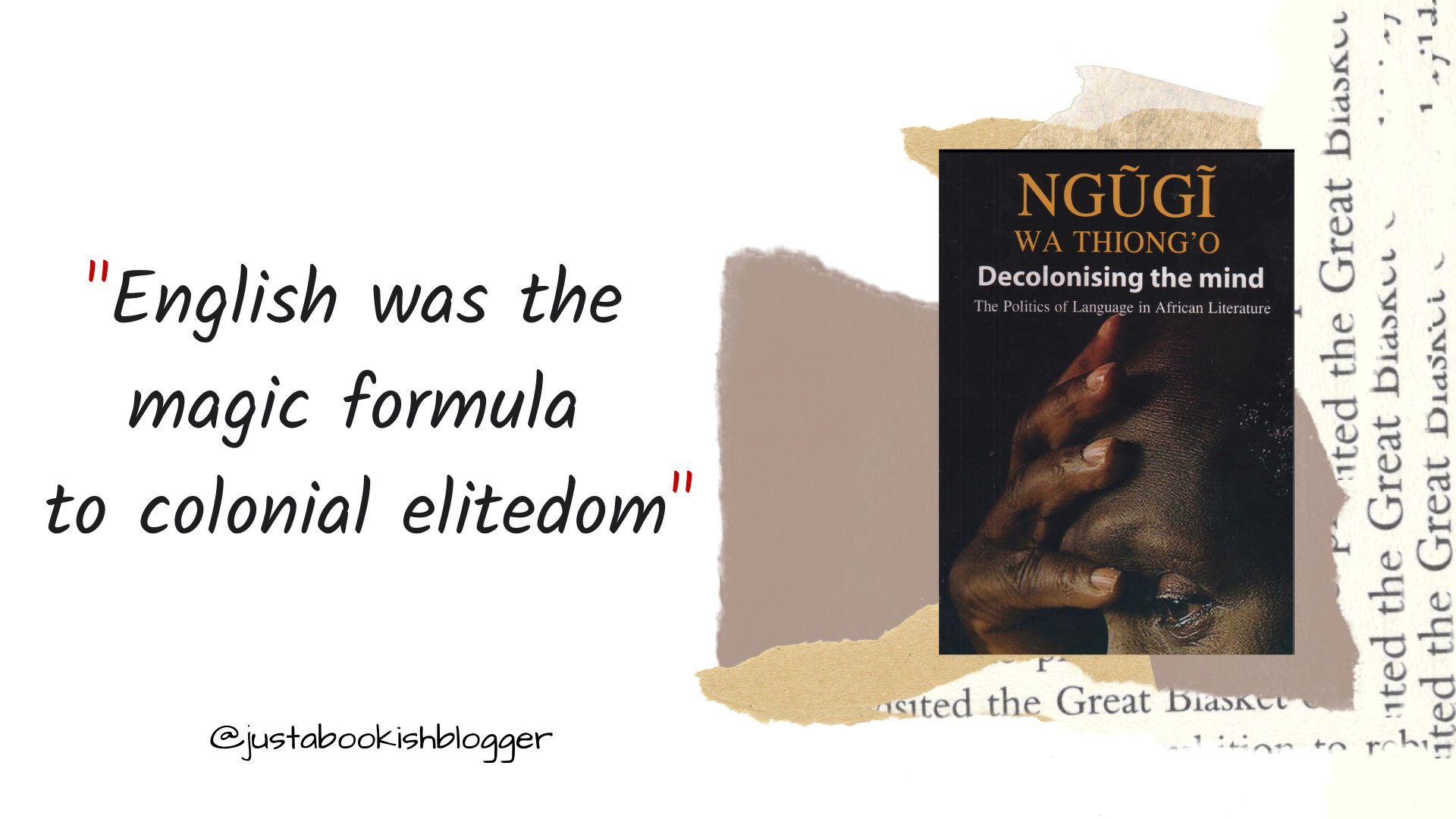
Attached below is an excellent piece of writing that made me realize the power of language. It was published in 1981 by Kenyan novelist Ngugi wa Thiog’o as a farewell to the English language. In it he describes how he was brought up in a Kenyan village where there was just one unifying language that bridged the gap across all communities. However with the arrival of the colonists this harmony was broken.
So how does it start? It starts with an ideology that a certain language is ‘the’ language. Anything otherwise is considered mediocre. This is gradually embedded into the education system where it becomes compulsory for children to learn the language, speak the language and then write in it. Without anyone’s knowledge this language becomes a part of us. Over time this language that was not part of our background, is used to describe our culture and day to day experiences. We may be of a different race, religion, and yet speak a language that is associated with neither. And this is what causes the ‘identity struggle’ experienced far and wide. For instance I identify as a Sri Lankan Muslim Moor. Yet I consider English as my first language because that is the language I am well versed in. However it is not related to my religion nor my race.
To better understand this, here is an extract from Ngugi’s essay which I believe resonates with the external interference in native educational systems that has led to an identity struggle seen in many parts of the world today:
And then I went to school, a colonial school, and this harmony was broken. The language of my education was no longer the language of my culture. (…)It was after the declaration of a state of emergency over Kenya in 1952 that all the schools run by patriotic nationalists were taken over by the colonial regime and were placed under District Education Boards chaired by Englishmen. English became the language of my formal education: In Kenya, English became more than a language: it was the language, and all the others had to bow before it in deference.
Thus one of the most humiliating experiences was to be caught speaking Gikuyu in the vicinity of the school. The culprit was given, corporal punishment – three to five strokes of the cane on bare buttocks – or was made to carry a metal plate around the neck with inscriptions such as I AM STUPID or I AM A DONKEY. Sometimes the culprits were fined money they could hardly afford. And how did the teachers catch the culprits? A button was initially given to one pupil who was supposed to hand it over to whoever was caught speaking his mother tongue. Whoever had the button at the end of the day would sing who had given it to him and the ensuing process would bring out all the culprits of the day. Thus children were turned into witch hunters and in the process were being taught the lucrative- value of being a traitor to one’s immediate community.(…) English became the main determinant of a child’s progress- up the ladder of formal education.
Selections from primary into secondary were through an examination, in my time called Kenya African Preliminary Examination, in which one had to pass six subjects ranging from Maths to Nature Study and Kiswahih. All the papers were written in English. Nobody could pass the exam who failed the English language paper no matter how brilliantly he had done in the other subjects. I remember one boy in my class of 1954 who had distinctions in all subjects except English, which he had failed. He was made to fail the entire exam. He went on to become a turn boy in a bus -company. I who had- only passes but a credit in English got a place at the Alliance High School, one of the most elitist institutions for Africans in colonial Kenya. The requirements for a place at the University, Makerere University College, were broadly the same: nobody could go on to wear the undergraduate red gown, no matter how brilliantly I had performed in all the other subjects unless they had a credit – not even a simple pass! – in English. Thus the most coveted place in the pyramid and in the system was only -available to the holder of an English language –credit card. English was the official vehicle and the magic formula to colonial elitedom. (Thiong’o: 1981)
How many of us on going to school change the way we perceive those at home? We may speak in our native languages at home, but on learning a different language and using it on a day to day basis we inevitably identify with the culture that comes with that language. We change the way we dress, speak, socialize and without our knowledge we are erasing the culture that we were born in. It is not only by speaking. It is inherent even in the way we write. I have been writing shorts stories and essays for a good fifteen years. Yet they were all with characters such as Edward or Mary and spoke of issues that weren’t synonymous with my background. Even in my first formative assignment for my creative writing module, I used British characters. I never gave it a second thought, although overcome with a sense of guilt for not sharing a part of my Asian culture, I did change the names and context of the story, to give off a more ‘Asian vibe’ in my final assignment.
This I guess was because, growing up I read books such as Nancy Drew, Goosebumps, Sweet Valley and of course Harry Potter, without realizing that I was convincing myself that books by their very nature were composed of characters that were foreign and spoke of things that I could not identify with. Recalling my brief period of teaching English as a second language in Sri Lanka, some of the children who came from different cultural backgrounds used foreign names in their essays. I guess I was partly to blame, giving them exercises with names such as Ann, Tom or Ben in them.
What we don’t realize is that in using the colonizer’s language to describe one’s culture, native writers are complicit in giving dominance to that language. With multiple people using that dominant language as a unifier or lingua franca, the native speakers of that language become an indestructible power house, like that of the Romans and British in the past. So that is why Ngugi bids farewell to the English language. Our fear of being not recognized or not understood for our work makes us resort to using a language that is understood by all. And that today is English.
Here is an extract from Ngugi’s essay of how identities and geographical boundaries are created in ‘third world countries’ by division of language by those in power:
‘It seems it is the fate of Africa to have her destiny always decided around conference tables in the metropolises of the western world: her submergence from self-governing communities into colonies was decided in Berlin; her more recent transition into neo-colonies along the same boundaries was negotiated around the same tables in London, Paris, Brussels and Lisbon. (…) Berlin in 1884 saw, the division of Africa into the different languages of the European powers. African countries, as colonies and even today as neo-colonies, came to be defined and to define themselves in terms of the languages of Europe: English-speaking, French-speaking or Portuguese-speaking African countries.’(Thiong’o: 1981)
We don’t give a second thought to the dominance associated with the use of a particular language. Let me give an example of how powerful the English language is today. Despite Britain voluntarily removing itself from the European Union (EU), English remains the official language through which all matters of the EU are discussed. Britain was the only country that represented the EU, where English is the official national language. Yet, to date there has been no discussion of resorting to another dominant language, say that of French or German.
I conclude with a quote from Nigerian novelist Chinua Achebe that relates to our natural tendency to speak and write in the dominant language even though we do not identify with its cultural implications:
“Is it right that a man should abandon his mother tongue for someone else’s? It looks like a dreadful betrayal and produces – a guilty feeling. But for me there is no other choice. I have been given the. language and I intend to use it.” (Achebe: 1975)
https://www.uibk.ac.at/anglistik/staff/davis/decolonising-the-mind.pdf
 The Bookish Blogger