
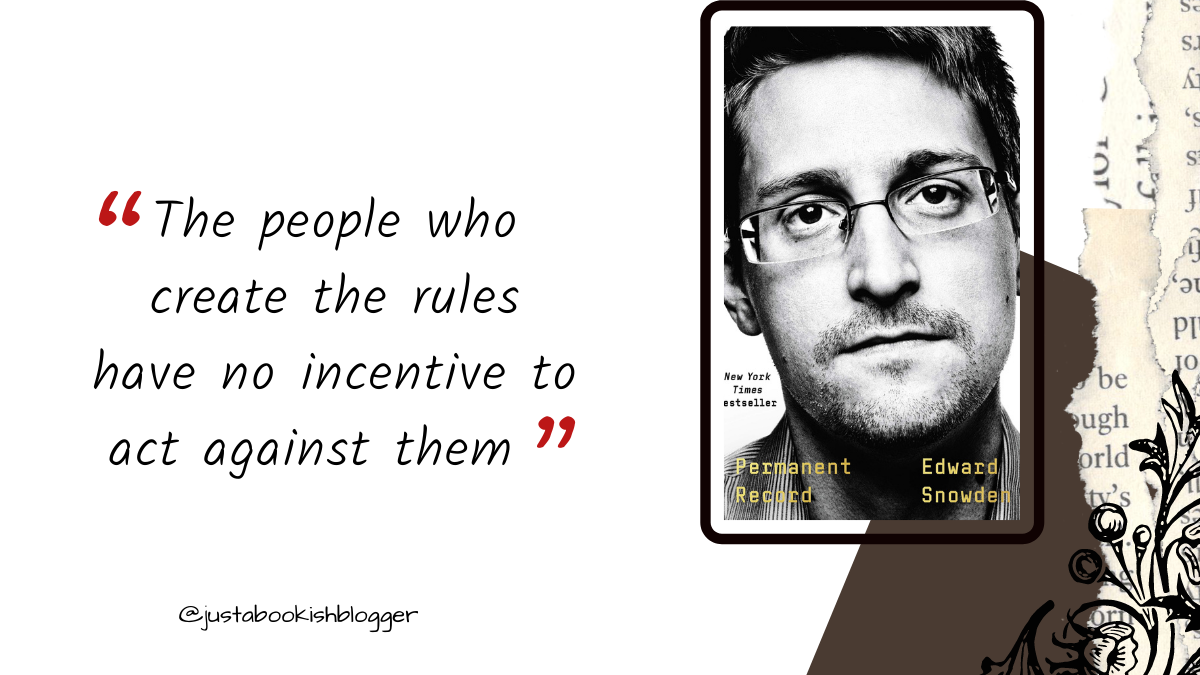
There’s so much to unpack in Snowden’s memoir, I honestly don’t know where to start! That coupled with all the technical jargon scattered across the book, made this a very difficult read. Many times I was so close to putting it down and calling it day. What kept me going was the struggle I went through to actually get the hard copy!
Anyways, I am glad I did complete it, because while the introduction and middle seemed very robotic (Snowden and Sheldon from The Big Bang Theory are very much alike!), the conclusion touched a nerve. Yes, his writing is rather hefty and at times it felt like he was barfing up a thesaurus, but I guess this was a result of the work he did and the people he moved with.
I was shifting between a two and a three for this book, but in the end decided to give it a 3.5. I put myself in his shoes and wondered what would I have done if I was in his position? If I knew someone was doing something so wrong, that millions (this is no exaggeration, it’s in all honesty more than a billion given the number of people who use the internet today!) were being affected, would I have just remained silent or tried to make things right? It would have most certainly torn me inside out, not having anyone to speak to. I cannot imagine what he actually went through, for a whole year, hiding what he knew was wrong and trying to figure out how best to put it.
I also realized that Snowden’s revelations were necessary. His story is difficult to read and understand, because even though we think we are technologically adept, there’s a world of things that we should know but don’t. This is why (to me personally) reading Snowden’s book was difficult. There was so much I didn’t know, (and I was under the impression I did!) especially about the footprints we leave online and how easily accessible our data is to a complete stranger.
I’ve divided my review into a three interesting areas of exploration. Do give it a read and let me know what you think!
Edward Snowden: hero or villain?
After the first few chapters, I decided that I do not like Snowden. He came off as a know-it-all and was rather disconcerting. Three incidents during his childhood stood out to support it and they were all rather shocking:
- Snowden opens his story by saying that the first thing he hacked was bedtime. He did so by resetting all the clocks in the house including those in the microwave and stove. And guess how old he was? Only SIX! What six year old does that? Or do six year old’s do that now?
- The next thing he hacked were his lesson plans. Realizing that school, studying and homework will cut down his computer time, he decided that the most important thing was to pass the class. Based on the weightage of each assignment and paper on the overall grade, he did some calculations and figured out a way to pass the class without doing any homework or term papers. Guess how old he was then? THIRTEEN! Reading this I felt so dumb, because I put a LOT of effort into my school work!
- He then found a huge security loophole in America’s largest and most significant weapons development agency (a nuclear laboratory no less!):an open directory structure that gave him access to the personal files of all its employees! He was then fifteen. He calls the institution, informs them of the loophole (of course he only speaks to the call centre guy) and then checks the website periodically to see if it’s fixed. Months later he gets a call from the agency with a job offer. His response: “During the school year I’m pretty busy, but I’ve got a lot of vacation and the summer’s are free.” Till this point the guys at the agency thought they were dealing with an adult.
You could argue that he was trying to be helpful. But I felt as though he was digging for trouble to have them fixed HIS way so that he can do whatever he wants and have control of important aspects in his life.Also these three incidents go to show that there are loopholes everywhere. You REALLY need to know where to look and a couple of calculations later you can get what you need and have overall control. The fact that Snowden understood this at a very young age is rather alarming. Plus you don’t have to crack websites to be a hacker. Snowden himself states:
“…hacking isn’t native to computing – it exists where rules do. To hack a system requires getting to know the rules better than the people who created it or are running it and exploiting all the vulnerable distance between how those people intended the system to work and how they actually work…hackers aren’t breaking the rules as much as breaking them.”
All this coupled with stories of how his family are descendants of the pilgrims and have always been patriotic to the country and its constitution made me feel like he was a villain who was trying to show the world that he’s actually not the bad guy by writing a book about his life.
However when he starts working for the CIA first and then the NSA, you could tell that he was genuinely concerned about the security loopholes within the agency and world at large. BUT even at this point I disliked him to a certain extent and felt like he was trying to show that he single-handedly identified the security threats and rectified them. I find it hard to believe that a country that was so far ahead in the cyberworld,was so far behind in terms of cyber security. Snowden even goes on to say that the NSA never backed up their files. I mean come on, they were the NSA, how could they not? This would mean that if they lost their data, the identities of all spies and intelligence officers around the world would be compromised. Taking recklessness to a whole new level!
Snowden states that from the time he started working for the NSA, he felt that something was not right. Mass surveillance first gained attention in 2005 during the Bush administration. However despite days of grilling by the congress, the intelligence community maintained that all surveillance were done on persons of interest who posed a threat to national security. While the congress bought this story, it was far from the truth. Since then the US has been working on gathering and preserving the data of everyone to be used at will. During his first few years Snowden says he did not come across anything that seemed ilegal, so he let it slide. However due to systems slip-up, Snowden got hold of a highly classified document that detailed everything on the mass surveillance. Why was it so disturbing? The internet surveillance was carried out using two methods:
- PRISM (a program to collect data that was launched during the Bush administration) and upstream collection. According to Snowden:”PRISM enabled the NSA to routinely collect data from Microsoft, Yahoo!, Google, Facebook, Paltalk, YouTube, Skype, AOL, and Apple, including email, photos, video and audio chats, Web-browsing content, search engine queries, and all other data stored on their clouds, transforming the companies into witting co-conspirators“.
- Upstream collection (I am quoting directly here): “…was more invasive and enabled the NSA to routinely capture data directly from private-sector Internet infrastructure—the switches and routers that shunt Internet traffic worldwide, via the satellites in orbit and the high capacity fiber-optic cables that run under the ocean. This collection was managed by the NSA’s Special Sources Operations unit, which built secret wiretapping equipment and embedded it inside the corporate facilities of obliging Internet service providers around the world.” (Okay so I am going to jump in and say that I didn’t really understand this bit and only got the part where he says this was more invasive than PRISM so I am assuming it’s bad).
Snowden says that many within the NSA were not aware of its exact dealings. It was only a close set of people who had access to this program and carried it out. Snowden too was in the dark and would have been that way if not for a technical mishap which brought the program right into his hands!
So this is the point where I started understanding his need to reveal what was going on at the NSA. By the time I was done with the book, I supported his decision and he’ll be a hero in my books!
Were there any outcomes after his glorious revelations?
Quite a few actually. But this is what I thought were important:
- Our social media and calls are now end-end encrypted because of him. Apple and Google took active steps to ensure all their devices and apps were end to end encrypted.
- The padlock or “s” that you see on some website addresses, was also implemented after this. There were some sites (banks, important government organizations and agencies) that had their websites encrypted before, however after his revelations more of the internet is encrypted and not unencrypted.
- There is a secure drop facility that is available in ten languages for whistleblowers. The information received on this facility is used by more than seventy media organizations around the world
- In 2016 the EU passed the General Data Protection Regulation which stated that people will be regarded as those who generate “identifiable data”. This means that any data generated by us will be deserving of civil liberties protections.
The internet and the tech world: fun facts!
- Metadata:
Snowden calls this activity data. In his words it is “a record of all the things you do on your devices and all the things your devices do on your own”. For instance, if you take a phone call, its metadata is the time at which the call was taken, the duration of the call, the date and the location. Interestingly most government organizations that carry out surveillance are interested in meta data and not data. However, according to Snowden cyber laws only protect the data; that is the actual content that transpires. In a phone call it would be the conversation carried out. I was not aware of this. On reading I realized how true this is. Why would governments be interested in our day-to-day conversations if we are not a person of interest? So why is metadata important? Snowden explains that this data can tell your surveillant “every place you visited during your day and how long you spent there. It shows who you were in touch with and who was in touch with you”. Unlike the conversations we can control, this data is taken off devices without any discretion. According to Snowden:
“metadata can tell your surveillant virtually everything they’d want or need to know , except what’s actually going on inside your head”.
- Internet traffic:
90 percent of the world’s internet traffic passes through technologies developed and or owned by the American government and American businesses – social media sites, search engines are all located in America and all come under American law. According to Snowden:
“…America remains the hegemon, the keeper of the master switches that can turn almost anyone on and off at will…”
This means that at any point the American government can cut off access (easier said than done of course) to social media sites, search engines etc anywhere in the world. Just think of the economic consequences a country would have if they decide to shut down a particular social media site.So many businesses operate online these days and many on Facebook and Instagram. This is why China has its own social media sites and search engines. I first saw it as rather totalitarian, but after reading Snowden’s book I feel like it was a smart move!
- The creation of irreality:
the use of similar words that have a lower impact to tone down the clandestine actions being carried out. Snowden states:
“…that the intelligence community used “illegal policies and shadow judiciary to permit kidnapping as “extraordinary rendition” tourture as “enhanced interrogation” and mass surveillance as “bulk collection”.
All actions carried out by the intelligence community requires congressional approval in the America. The agencies reworded their documents to tone down their actions and according to Snowden the report that was given to congress was in most cases very different to the internal report. I actually watched a movie on the “enhanced interrogation techniques” that was based on a true story. The movie titled The Report tells the story of an intelligence officer who works tirelessly with the congress to show that these techniques were actually unwarranted torture. It was also shocking because in many cases most agencies weren’t held accountable because they hired private contractors who in turn hired subcontractors to do their dirty work for them. By the time the dots were connected the perpetrators had long escaped, probably in their beachside mansion in the Bahamas! Watch the movie if you have the stomach. I closed my eyes during most parts, because the torture was just too horrible to watch and the fact that they got away with it by calling it “enhanced interrogation” is just appalling.
- Spying on webcams
Do you know that the intelligence community can spy on you through your webcam? I was aware of this after watching Snowden’s movie, and a couple of google searches later, my webcam has been covered since 2015. I suggest you go ahead and do it too, because what they do with these videos as detailed in Snowden’s memoir is rather alarming.
Bonus facts from the book!
- Snowden was sheltered by a Sri Lankan family seeking asylum in Hong Kong when his hotel location was known. To this day, Snowden says he is grateful to the family for welcoming a complete stranger into their home and providing him with food, clothing and shelter. Snowden also says that in comparison to him, this family had gone through unfathomable challenges running away from the civil war that took place in Sri Lanka back in the day.
- Today according to Snowden embassies around the world are established primarily for spying purposes as opposed to building diplomatic relations. Snowden mentions that in any embassy there are numerous spy cams and wiretapping devices installed unknowingly to keep watch on all day to day dealings. (Be on your best behavior next time you walk into an embassy!) I was a bit sceptical of this at first, but then remembered the Khashoggi murder and remembered how the Turkish authorities stepped forward and said they’ve got the recordings of everything that happened!
Overall rating: 3.5/5
Fact box
Author: Edward Snowden
Release date: 17th September, 2019
Genre: Memoir
Newspaper Reviews
The Guardian
Rating: Not stated
“The call of duty and a patriotic pedigree are given priority in Snowden’s account of his motivations – and he warns of dangers ahead.”
 The Bookish Blogger